Kirk Web Design

Interactive design engineering / Vincennes, Indiana

We build interfaces that respond.

Kirk Web Design designs and engineers websites where scroll, pointer, touch, and time are part of the interface.

The field behind this text is live: move the pointer, drag a brass anchor, or scroll. Anchors also take the arrow keys.

Static is the fallback.

Every page here is complete HTML before any script runs. Motion is layered on top as rules, and anyone who turns motion off gets a still frame of the same design rather than a lesser page.

Input. Rule. Response.

Every movement has an input, a rule, and an outcome. We design all three.

Choose one of each. The stage and the field behind it run on the same engine, so all 125 combinations work, and the brass anchor on the stage shows the rule at work.

Input
Rule
Response

Move the pointer across the stage. With the keyboard, focus the stage and use the arrow keys.

This demonstration runs in the browser with JavaScript. Five inputs (pointer, scroll, drag, focus and time) feed five rules (spring, constraint, timeline, inertia and snap), which drive five responses: type, image, layout, depth and navigation.

Selected work

Five client sites, shown as captures of the live sites. The framing and transitions belong to this page; each project is described as it was built.

Arrow keys move between projects.

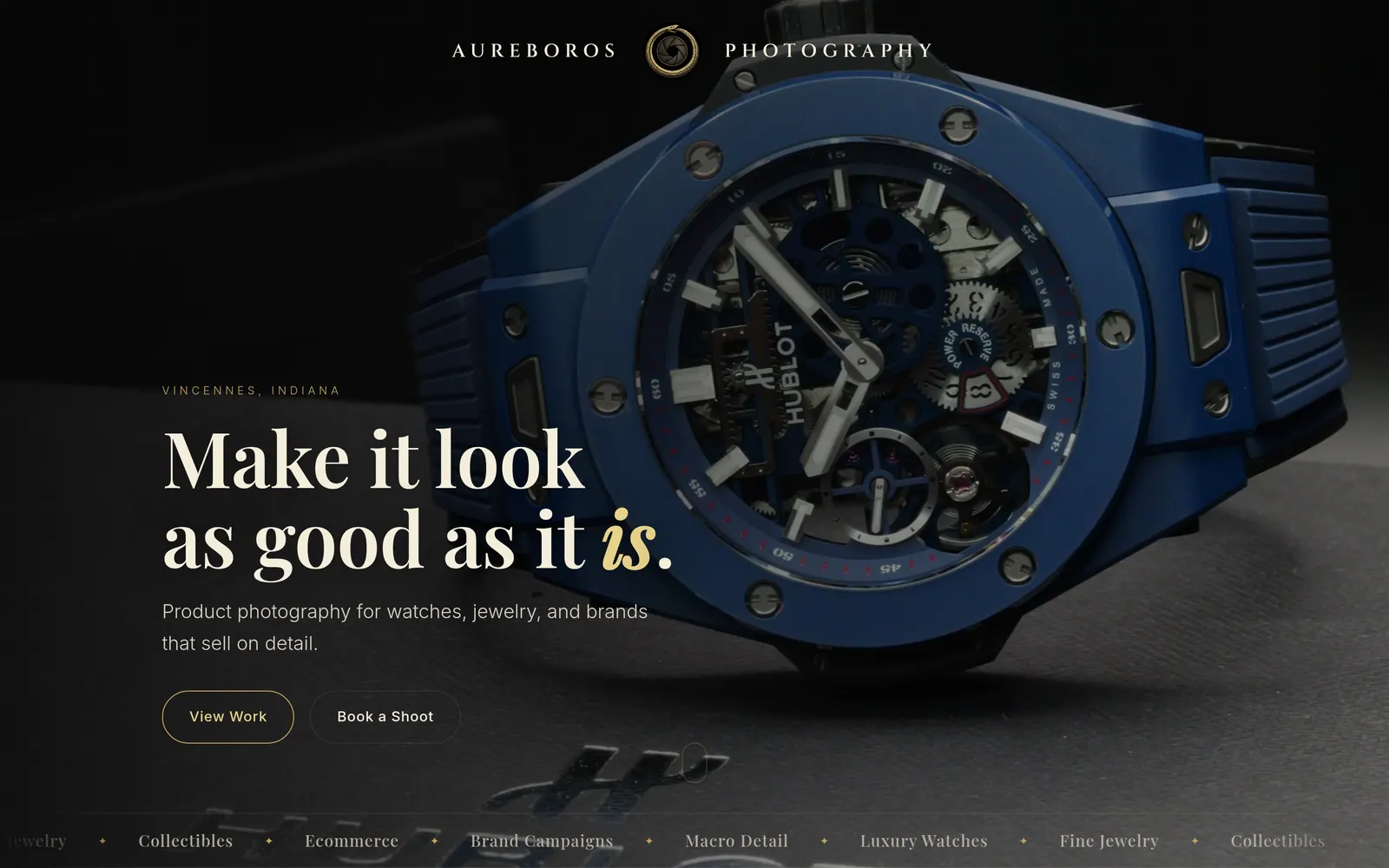
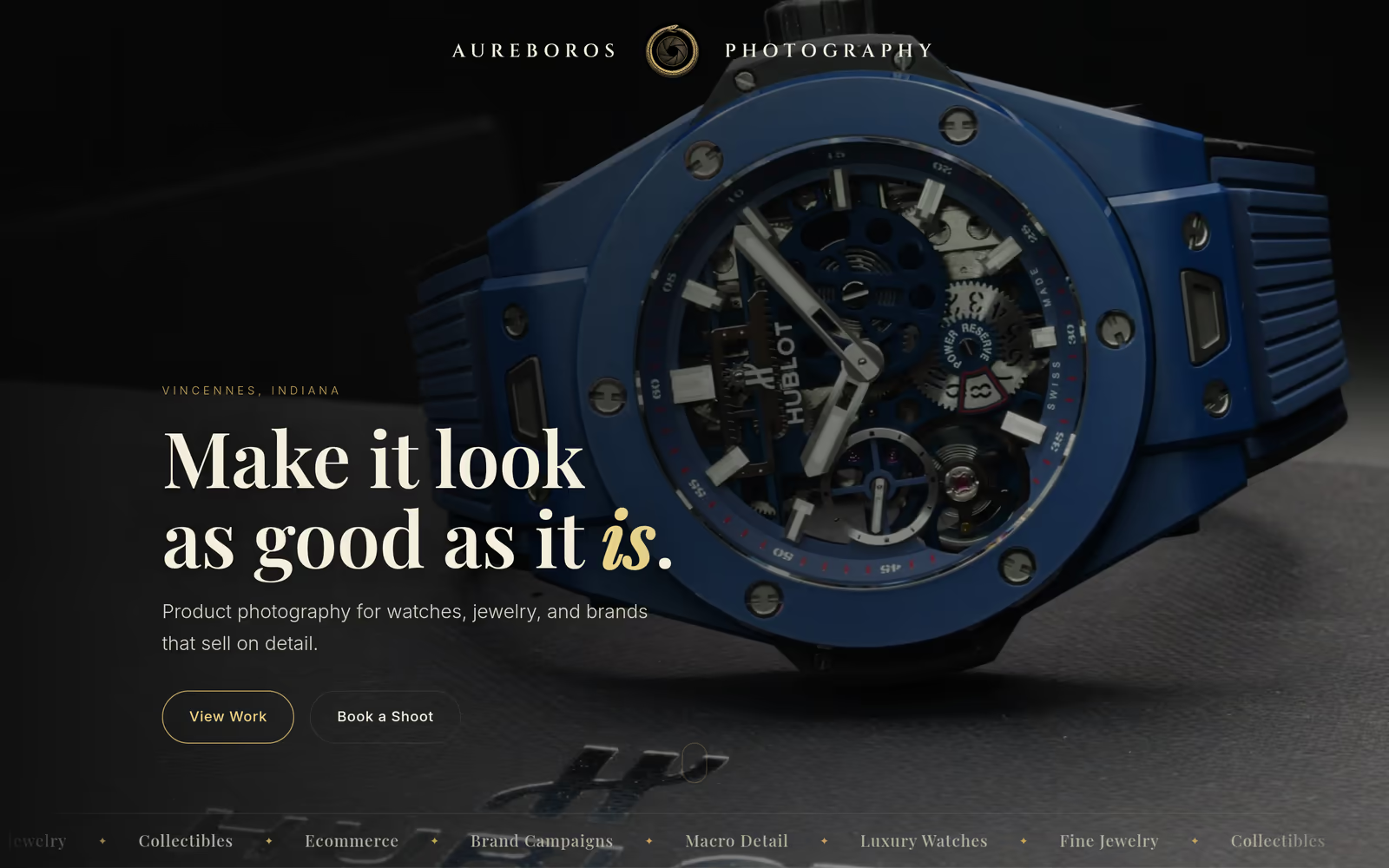
Capture of the Aureboros Photography homepage: a watch photographed on black under the headline “Make it look as good as it is.”

Aureboros Photography

Industry
Product photography, Vincennes, IN
Scope
Structure, copy direction, design, development
Live site
aureborosphoto.com

Problem

A studio that sells on visual quality needs a website that works as its own portfolio.

Approach

An image-first build: a full-bleed photographic hero, an editorial work grid with captions set over the images, and one stated rate of $80 per hour in place of package tiers.

Open the case study
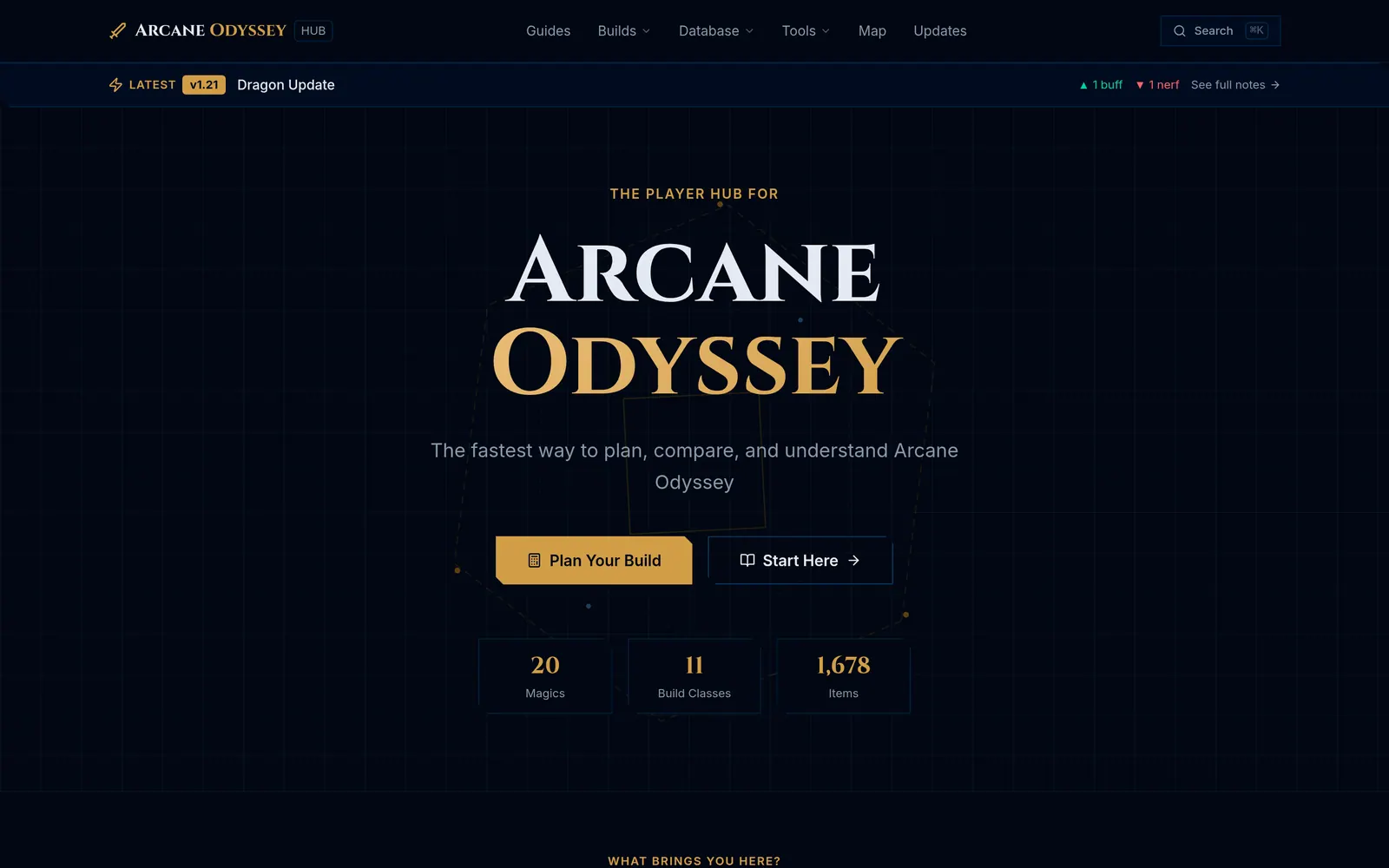
Capture of the Arcane Odyssey Hub homepage: the game title above build and guide links and counts of 20 magics, 11 build classes and 1,678 items.

Arcane Odyssey Hub

Industry
Gaming reference, online
Scope
Information architecture, design, development
Live site
arcane-odyssey.com

Problem

A large, frequently patched body of game data had to stay searchable, comparable and trustworthy.

Approach

A reference layer of 20 magics, 31 bosses and 1,678 items behind one keyboard-accessible search, with a build calculator and tier lists stamped with the patch they describe.

Open the case study
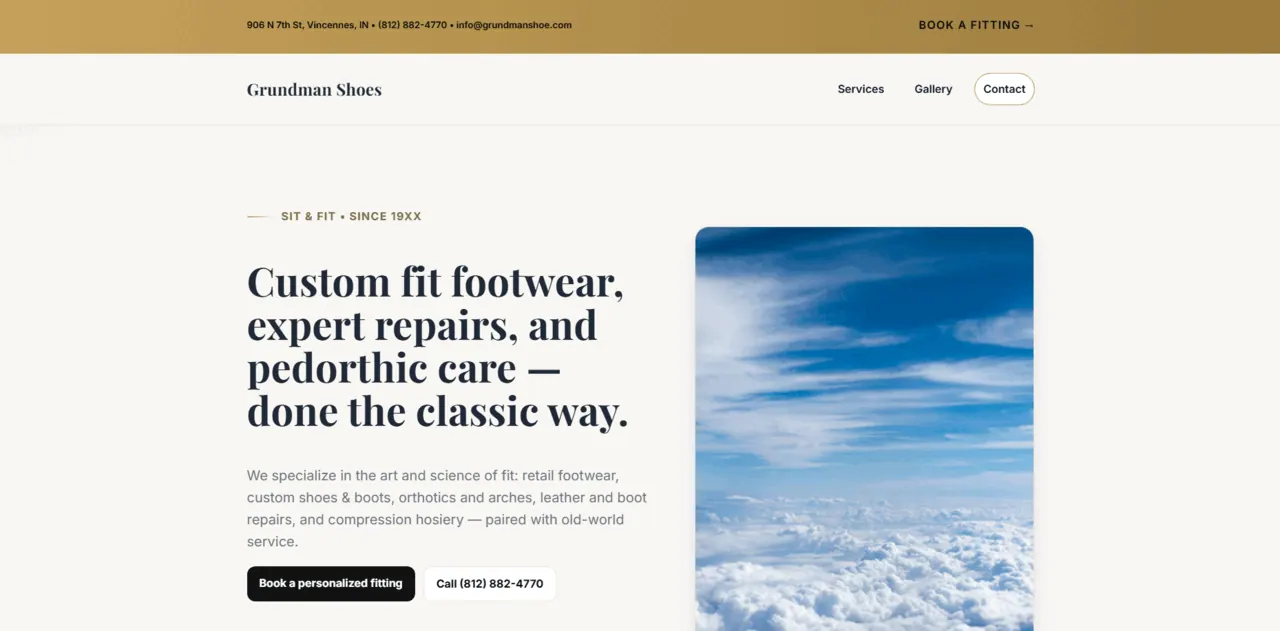
Capture of the Grundman Shoe homepage: “Custom fit footwear, expert repairs, and pedorthic care, done the classic way.”

Grundman Shoe

Industry
Retail, Vincennes, IN
Scope
Design, local search, content
Live site
grundmanshoe.com

Problem

A long-standing store with strong local name recognition had no website to reach new customers.

Approach

Hand-coded pages that organize products by category, feature the brands carried and keep directions and calling one step away, with local structured data throughout.

Open the case study
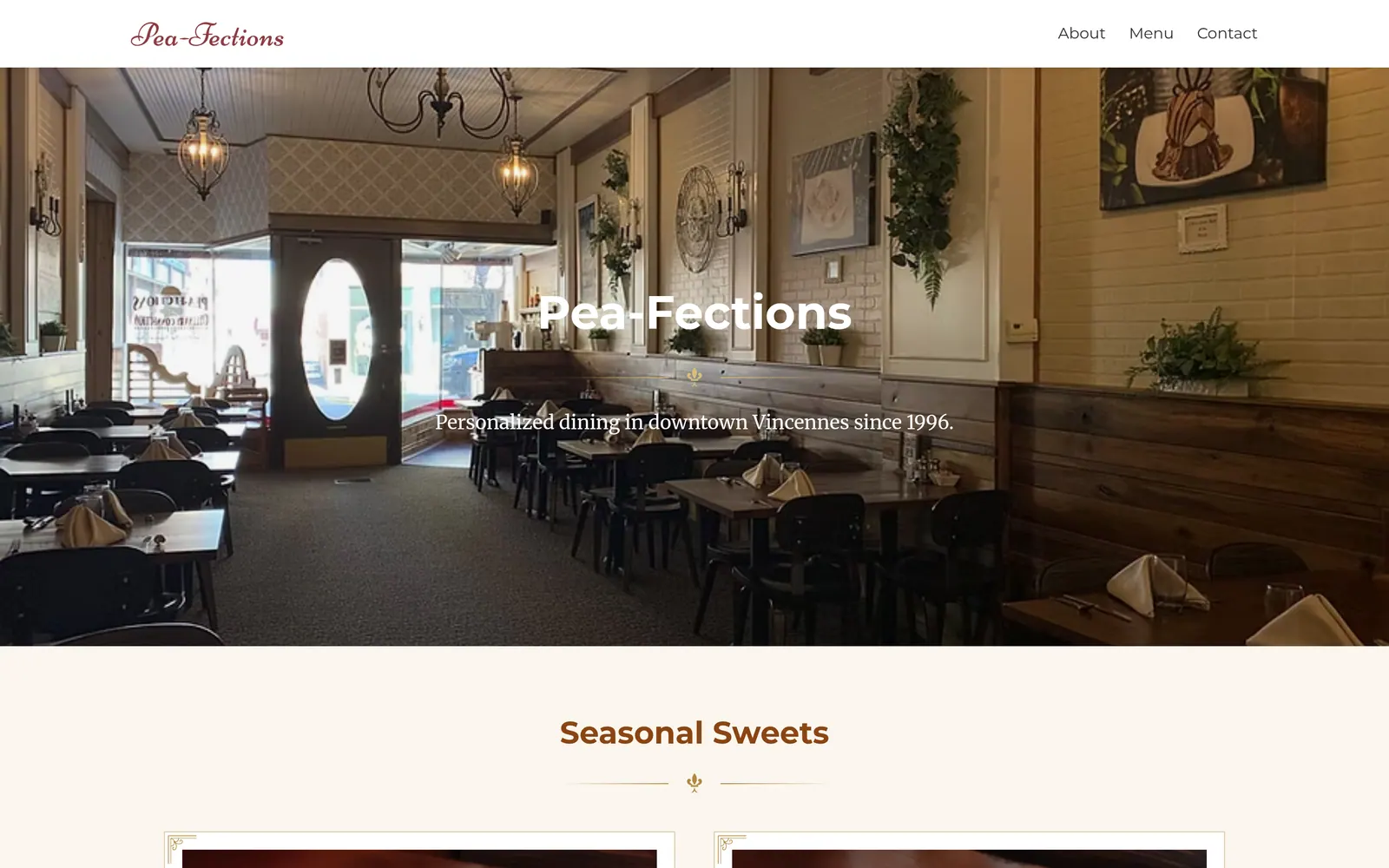
Capture of the Pea-Fections homepage: the dining room of the downtown Vincennes shop under the name Pea-Fections.

Pea-Fections

Industry
Bakery, Vincennes, IN
Scope
Design, local search, content
Live site
pea-fections.com

Problem

A bakery known through word of mouth was invisible to people searching nearby.

Approach

A warm, photograph-led site that puts the products first and makes the menu, hours and contact details easy to reach from any device.

Open the case study
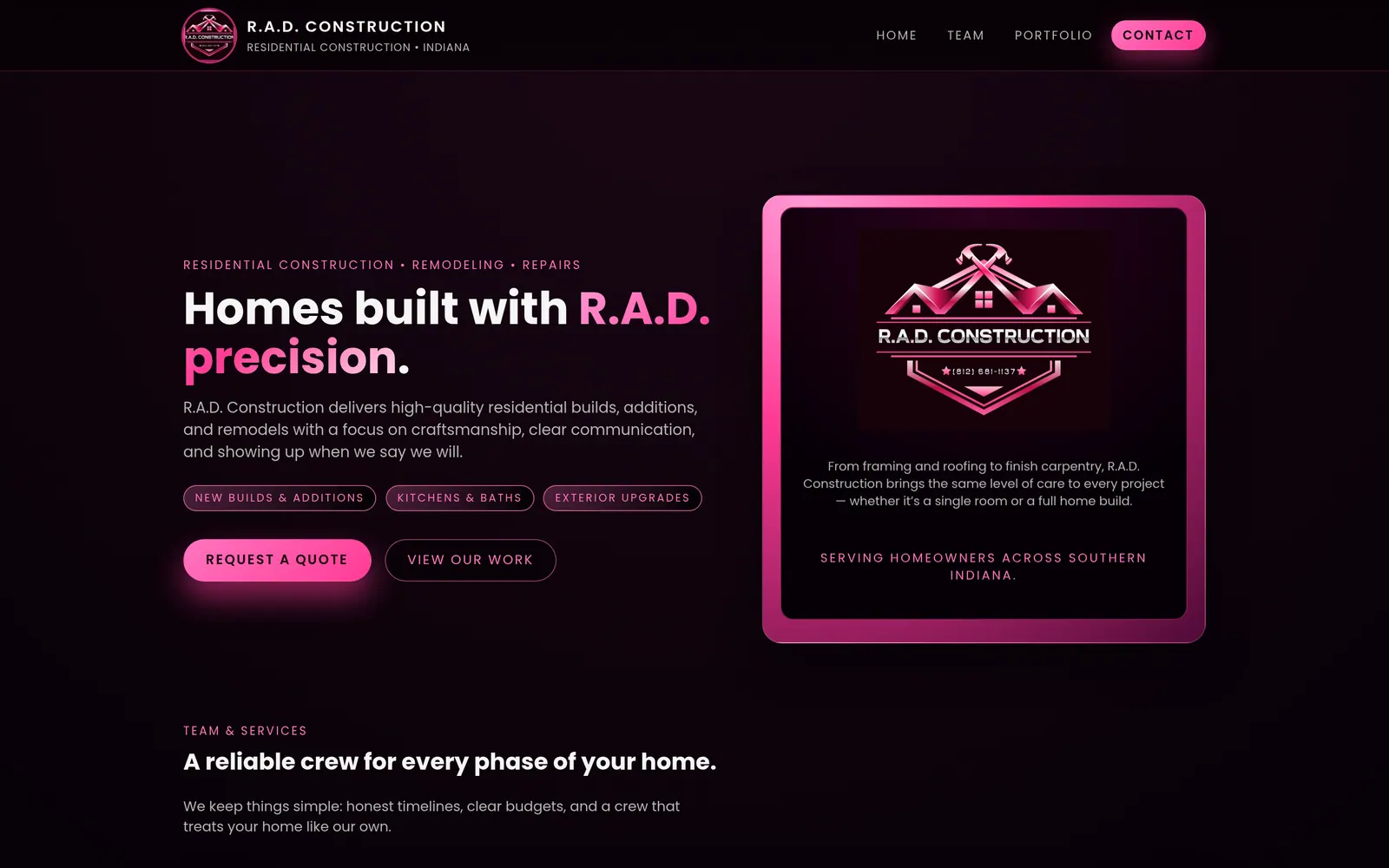
Capture of the R.A.D. Construction homepage: “Homes built with R.A.D. precision.” beside the company badge, with a Request a Quote button.

R.A.D. Construction

Industry
Construction, Indiana
Scope
Design, local search, content
Live site
radconstruction.org

Problem

A growing builder bidding for larger projects needed to earn trust before the first meeting.

Approach

A custom-coded multi-page site that states services early, keeps contact details prominent and leads each page toward a quote request, built for clients browsing from job sites.

Open the case study

All ten client projects

Interaction studies

Self-initiated experiments built on the same engine as the field. They are studies, not client work.

Study, self-initiated

Elastic type

Every letter returns.

Each letter is a spring with four degrees of freedom: horizontal and vertical position, width and weight. Pointer speed loads the letters nearest to it, and critical damping returns each one to exactly where it started. The sentence stays live text for screen readers and search.

Study, self-initiated

Media under tension

Capture of the Aureboros Photography homepage, seen through a five-sided aperture.

A capture seen through a five-node aperture. Every node is held by a spring to its rest position and by constraints to its neighbors, so pulling one opens the frame and drags the others with it. The capture is cropped by the frame, never stretched.

Drag either brass handle, or focus one and use the arrow keys.

Opening 41% of the frame

Study, self-initiated

Scroll topology

Nine pages of a website drawn as a network. Scrolling changes it from a site-map tree, with Home at the top, into a single scroll sequence that zigzags from Home to Contact.

Nine pages as two structures: a site-map tree and a single scroll sequence. Each node is a spring chasing a position computed from scroll progress, so scrolling back up reverses the change exactly. With reduced motion it switches between the two states with nothing in between.

Structure Site map

Interaction is a system, not an effect.

Everything on this page runs on one system with seven layers. Select a layer to isolate it in the live specimen.

Input

Pointer, touch, keyboard and scroll arrive as signals with a position, a velocity and a timestamp. Speed is measured in viewport diagonals per second, so a flick means the same on a phone as on a wide monitor.

Pointer
—
Speed
—
Scroll
—
Focus
—

State

The field is always in exactly one mode: idle, pointer, drag, scroll or focus. A mode decides which forces apply. It never changes what the content says.

Mode
—
In mode for
—
Recent
—

Motion

Each node is a damped spring pulled toward a rest position, stepped a fixed 120 times per second whatever the display’s refresh rate. Forces are clamped, so a fast flick cannot throw the system.

Springs
—
Step
—
Energy
—

Rendering

Text and controls are HTML. Lines and anchors are one canvas, capped at twice the device pixel ratio. Project captures are real images clipped by a polygon, so nothing essential exists only as canvas pixels.

Canvas
—
Nodes
—
Draw
—

Accessibility

Reading and focus order follow the document, not the animation. Every drag has a keyboard path, changes that matter are announced, and a reduced-motion setting replaces springs with still frames.

Reduced motion
—
Field
—

Performance

The loop sleeps when the field is at rest, stops when the tab is hidden, and skips sections that are off screen. Captures are AVIF or WebP at the width the screen needs.

Loop
—
Frames
—
Sleeps
—

Fallback

Without JavaScript, or with motion turned off, the page shows a still frame of the same geometry. Every link, form and project works the same way.

What the studio builds

Each line is a service offered today: what the work is, what a visitor would notice, how it is usually built, and where on this site it can be seen working.

Capabilities, with what each changes for visitors, how it is usually built, and an example
CapabilityThe workWhat a visitor noticesUsually built withSee it
Interaction directionDeciding what every input does: which gesture moves what, how far, and how it settles.Controls behave predictably; nothing moves without a cause.HTML, CSS and JavaScript prototypesInput. Rule. Response.
Motion systemsOne set of durations, easing curves and spring values, applied everywhere.Transitions share one rhythm across the whole site.CSS custom properties, a small spring engineThe field
Scroll choreographyLayout and imagery tied to scroll position without taking over the scroll wheel.Long pages read as a sequence, and scrolling back reverses it.Scroll progress, sticky positioning, transformsScroll topology
Canvas renderingDense line and node systems drawn where HTML elements would be too heavy.Detailed visuals that stay smooth on ordinary hardware.2D canvas with a capped pixel ratioTechnical anatomy
Data-heavy interfacesLarge datasets made searchable and comparable.Visitors answer their own question in a few keystrokes.Hand-built front end, client-side searchArcane Odyssey Hub
Responsive behaviorA separate interaction model for phones rather than a shrunken desktop.Touch gestures never fight with scrolling.Pointer and touch handling per breakpointSelected work on a phone
Accessibility and reduced motionKeyboard paths for every gesture, semantic HTML, still equivalents for motion.The site works with a keyboard, a screen reader, or motion turned off.Semantic HTML, ARIA where HTML falls shortMedia under tension
PerformanceBudgets for images, scripts and rendering work.Pages load quickly and stay responsive on mid-range phones.AVIF and WebP, render suspension, hand-written codeTechnical anatomy
Strategy and contentShaping what the site says before deciding how it moves.Visitors understand the offer quickly.Page architecture, copy directionAureboros Photography
Search foundations and careStructured data, technical cleanup and maintenance after launch.The site stays accurate and easy to find.Schema.org markup, monitoring, updatesServices
Elijah Kirk, founder of Kirk Web Design

Who does the work

Kirk Web Design is the website studio of Kirk-Co LLC, based in Vincennes, Indiana. Elijah Kirk leads the strategy, content direction, interface design and development, so the decisions made while learning a business carry through to the finished site.

The studio is intentionally lean. When a project genuinely benefits from photography, specialist writing or a particular technical integration, the right collaborator is brought in without turning the work into a chain of handoffs.

Elijah Kirk Founder and lead developer

Based in
Vincennes, Indiana
Works with
Businesses and organizations across Indiana
Projects
Website projects start at $750. Managed and care plans are on the pricing page.

About the studio
Bring us the part that has to feel impossible.

Good fits: work that has to be shown rather than described, a reference tool with more data than a menu can hold, or an existing site that should feel faster and clearer. Describe what has to happen on screen. Elijah replies within one business day.

Include an email address or a phone number. No mailing list and no sales sequence. Prefer more room? Use the full project form.